Trend, explained
Celebrity Parents Filter
The filter that put two famous faces next to your selfie never measured your face at all. Here is what it is doing, how to run the same idea in a browser in one upload, and how to read the pair you end up with.
Ready when you are
One selfie is enough. Your first result is free and nothing is stored.
What the filter is
The celebrity parents filter is a short video effect. You upload a selfie, the effect drops two famous faces beside yours and labels them your mother and your father, and the clip ends on the reveal. It spread through CapCut templates and TikTok stitches at the end of 2025 and has kept resurfacing since. The result is built to be screenshotted, which is the entire point.
Treat it as a costume for your feed, not an answer about your face. Both can be enjoyable at the same time, as long as you know which one you are looking at.
What the template is really matching
The templates people share are not measuring anything about you. They place your photo next to a pair drawn from a fixed list. That explains the two things that puzzle people most: the same face can get different parents on two different templates, and two friends who look nothing alike can be handed the same couple.
Nothing about that is dishonest. It is an effect. It becomes a problem only when someone reads a template draw as a verdict on their face.
The version that actually measures
A measured match starts by reducing the photo to landmarks: face length against cheekbone width, the distance between the pupils, the width of the nose bridge and tip, the jaw angle, the mouth line and the position of the brows. Those are descriptions of a face, not opinions about it.
The pairing step then asks a harder question than a look-alike tool asks. It scores couples, not individuals, so one parent can carry your upper face while the other explains your lower face. You get a pair, a resemblance score out of 100, and the features that produced the score.
How to run the same idea in a browser
You do not need to install anything, and you do not need an account for the first run.
- Take a plain, front-facing photo. Even light, neutral expression, hair off the brow line.
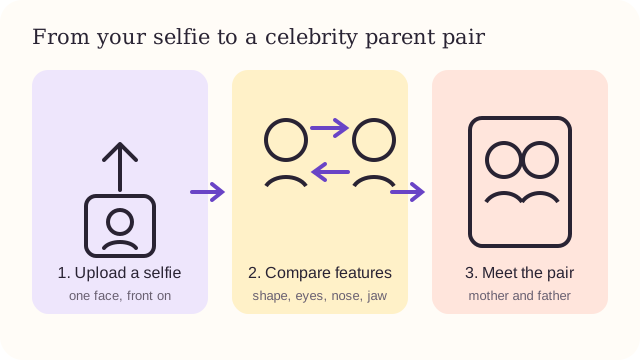
- Upload it once. The analysis runs on that single image and returns your closest celebrity parent pair.
- Unlock the report. The free result gives you the pair and the score. The full report adds the alternate pairs and the per-feature breakdown.
The photo is analysed and discarded. It is not added to a library of faces and it is not used to train anything.
Reading the pair you get
A parent pair is not two look-alikes stapled together, so a result can feel wrong at first glance. Check the split before you judge it.
Which celebrity explains which half
The report names the features each parent carries. Usually one celebrity accounts for the upper face — brow line, eye spacing, cheekbones — and the other for the lower face and jaw. Read the features, then look at the two tiles again.
Why the alternates matter more than the winner
The second and third pairs show which features are stable in your face and which are borderline. If the same face keeps appearing across pairs, that feature is doing real work. If only the top pair contains it, it was a coin toss.
Change one thing at a time
Angle, light and expression all move the geometry. Re-run with one variable changed, or you will never learn which change moved the score.
Frequently asked questions
Is the celebrity parents filter free?
The effects themselves are free inside the apps that host them. This site runs one photo analysis without an account, and the full report with alternate pairs and the feature breakdown is what credits unlock.
Why did my friend get the same celebrity parents as me?
Because the template is drawing from a fixed list rather than measuring faces. A measured match compares your own landmarks, so two different faces normally return two different pairs.
Do I need CapCut to do the celebrity parents filter?
No. CapCut hosts one popular version of it. Any browser can run a parent match, and a browser version can report a score and a feature breakdown that a short video template does not show.
Is this a DNA test or a family test?
No, and it cannot be. It compares visible facial geometry with a roster of famous faces. It knows nothing about your family and cannot identify anyone.
Can I use a photo I did not take?
Use your own. Uploading someone else's face to a matching tool is a decision about their data, not only yours.