The whole category
Celebrity Look Alike
Every look-alike tool answers the same question with a different rule. Knowing which rule it uses tells you why two of them can hand you two different famous faces.
Ready when you are
One selfie is enough. Your first result is free and nothing is stored.
What a look alike tool is doing
Strip away the interface and a look-alike finder is a search for the nearest neighbour. Your photo becomes a set of measurements, the library becomes a set of the same measurements, and the tool returns whichever famous face sits closest. The interesting difference between tools is not the artwork. It is what they measure and what they measure against.
One face, or a pair
A single-face tool ranks individuals. It returns the one celebrity whose overall geometry sits nearest yours, which is exactly the right answer to "which famous person do I look like".
A pair-matching tool ranks couples. It has to explain how two faces combine, so it may prefer a couple whose individual members sit further from you than your closest single match. That is not a contradiction between the tools. They are optimising different questions.
How the score is built
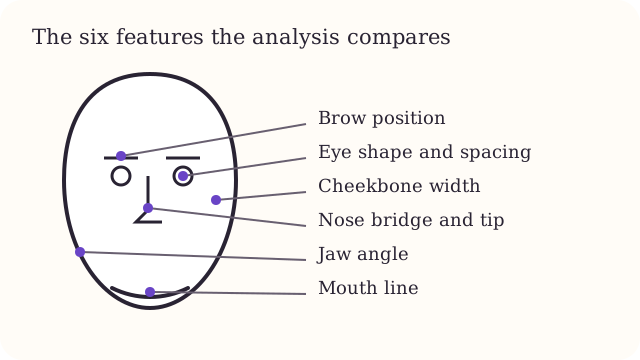
A useful match is not one number falling out of a box. It is a comparison across named features: face shape and length-to-width ratio, cheekbone width, eye shape and spacing, nose bridge width and tip, jaw angle, mouth line, brow position and hairline.
When a result names the features that carried it, you can check the claim against the photo. When a tool returns only a percentage, there is nothing to check.
Why your answer changes between uploads
The same face scores differently across photos, and the causes are mundane: a turned head compresses one side of the face, a wide lens exaggerates the nose, hard light flattens the jaw, a smile changes the mouth line. None of that is the tool malfunctioning. It is the input changing.
What the free result shows
One upload gives you your closest celebrity parent pair, a resemblance score out of 100, and the features behind it. The full report adds the next pairs down the ranking and the per-feature breakdown, which is where the result stops being a name and starts being an argument.
Checking a tool before you upload
Three questions, in this order.
What does it do with the photo?
A tool that stores the selfie has a different risk profile from one that discards it. Uploading a face is not like uploading a screenshot.
Does it measure, or does it draw?
A generative effect invents faces. A matcher compares real measurements against a fixed roster. Both are entertainment, but only one of them is answering your question.
Does it explain the score?
If the result cannot name which features carried the match, treat it as a caption rather than an analysis.
Frequently asked questions
Is celebrity look alike matching free?
The first photo analysis here is free without an account. Credits unlock the full report: the alternate pairs and the feature-by-feature breakdown.
Why is my celebrity match different on a different site?
Different tools measure different features and compare against different libraries. Change either one and the nearest neighbour changes with it.
Which celebrity do I look like the most?
The tool returns the closest match it can defend, plus the features that produced it. Resemblance is structural, so the honest answer always comes with its reasons attached.
Can a look alike tool identify someone?
No. It compares visible geometry against a public roster of famous faces. It cannot identify a person, and it knows nothing about anyone's family.