First-person, one upload
My Celebrity Parents
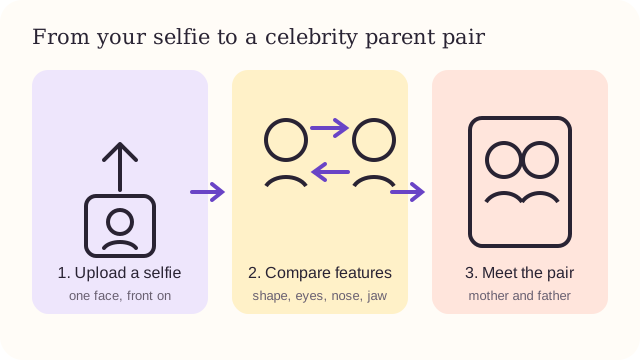
My celebrity parents is the first-person version of the question. You are not browsing a list of famous families. You want two names that explain your own face. Upload one front-facing selfie below; the free run returns the pair, and the photo is discarded.
Sign in to unlock the full report and spend your free credit.
What the first-person question is actually asking
My celebrity parents is not a request for a magazine list. It is a request for a ranking: which two famous faces, taken as a couple, land nearest to the face in this photo. A list of famous families answers a browse. A ranked pair answers you.
That is why the page hosts the uploader instead of another essay about celebrity children. The only honest answer to a first-person query is a comparison against a fixed roster, with the features named so you can argue with them.
Why a couple explains a face better than one star
A single look-alike is a nearest-neighbour search. My celebrity parents is a combination search: one parent can carry the upper face while the other explains the jaw, the mouth and the chin. Faces are inherited in pieces, which is why a pair is the right shape of answer.
If you only wanted one famous face, the page that answers that is my celebrity look alike. Keep the two questions apart and you will not read a couple as a single twin wearing a second name.
How one selfie produces a stable pair
The comparison reduces the photo to landmarks: face length against cheekbone width, the distance between the pupils, the nose bridge, the jaw angle, the mouth line and the brow position. Those numbers are scored against every couple in the roster. The winner is the pair whose blend accounts for the most of that geometry.
A front-facing photo in even light, with a neutral expression and hair off the brow, is the one that repeats. A wide smile shortens the visible face; a lens held close stretches whatever is nearest it. Change one of those and the pair can move.
What the free names include, and what they withhold
The free run of my celebrity parents returns the closest couple by name. The resemblance score, the feature breakdown and the two alternate pairs sit behind one credit — about $2.99 — and a new account starts with one credit free.
That split is deliberate. A visitor who has not seen the names yet is still deciding whether the tool is real. A visitor who has the names can decide whether the working is worth opening.
How to argue with the couple you were given
- Cover one tile. Hide each parent in turn. A strong pair still explains half the face when the other tile is gone.
- Read the feature list. If the report says eye spacing carried the match, look at the eyes, not the whole photograph.
- Re-run with one change. A second photo should move the score slightly, not overturn the pair. If it overturns, the first photo was doing the work.
A pair you can argue with is a measurement. A pair you can only accept is a caption.
When the first-person question is the wrong one
If you wanted a CapCut-style reveal for a story, the template page is CapCut celebrity parents. If you wanted a five-question draw with no photo, that is the celebrity parents quiz.
My celebrity parents is for the visitor who already has a selfie and wants two names. That is a narrower job than the homepage, and it is the job this URL is for.
Frequently asked questions
What does my celebrity parents actually return?
The two famous faces whose blended geometry comes closest to your photo, against a fixed roster of couples. The free run names the pair; the score and the breakdown open with one credit.
Is my celebrity parents free?
The first analysis is free and needs no account. It returns the closest couple by name. The full report is one credit, and a new account starts with one credit free.
Does this identify my real parents?
No. It is entertainment. Facial resemblance skips generations and is moved by angle, light and expression. Treat any claim about a real family as unproven.
Why did a friend get a different couple?
Different photos, different angles, different expressions. The roster is fixed; the input is not. Two honest photos of the same face should land near each other, not identically.