Two faces, one match
Celebrity Look Alike Parents
Most look-alike tools stop at one face. Parent matching asks a harder question: which famous couple could combine into your face? Sign in and buy credits before photo analysis. One credit includes the full report.
One face versus a pair
A single look-alike match is a distance problem: find the famous face nearest to yours on shape, eyes, nose and mouth. A parent match is a combination problem: find two famous faces whose blend lands nearest to yours.
Combination matching is stricter. One parent has to carry your upper face, the other your lower face, and the pair has to stay plausible when the features are mixed.
Which features survive the blend
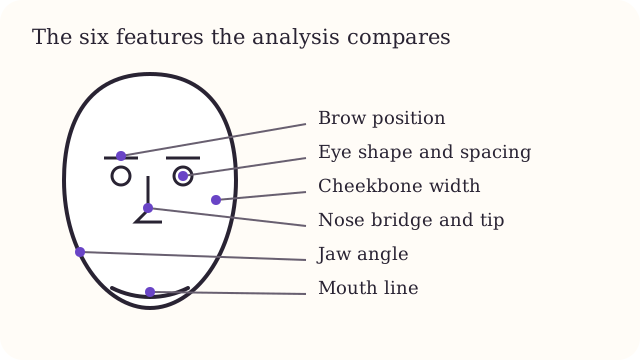
- Upper face — brow position, eye shape and eye spacing usually decide the first parent.
- Mid face — nose bridge width and cheek projection are the tie-breakers between two candidate pairs.
- Lower face — jaw angle, chin projection and mouth line usually decide the second parent.
- Framing — hairline and face width rarely decide a pair on their own, but they break near-ties.
Reading a celebrity look alike parents result
Each pair in your report lists the two celebrities, a resemblance score, and the features that carried the match. Read the features first: a 68 with a precise explanation is more useful than an 84 with none.
The full report also shows your alternate pairs. Looking at pairs two and three tells you which features are stable in your face — the ones that appear in every pair are the ones the model trusts.
Why the pair is not always your favourite celebrity
The generator optimises for explanation, not for fame or flattery. A pair of two mid-career character actors whose eyes, nose and jaw line up will beat a pair of A-listers whose faces only half-fit, because the midpoint of the second pair lands further from your face.
That is also why the same upload can produce a surprising answer that is hard to unsee once the feature list is on screen.
How to explain your match to someone else
Lead with the pair, not the score
A number on its own invites an argument you cannot win. "The generator gave me a 78" means nothing to a friend. "These two together explain my face better than any single celebrity" is a claim they can check, because they know your face.
Name the feature that decided it
The report always tells you which feature carried the match: eye spacing, jaw angle, nose bridge, mouth line. Say that out loud. It turns a vague impression into something specific enough to agree or disagree with, which is the entire point of the exercise.
Say what it is not
Celebrity look alike parents results are entertainment. Saying so first stops the conversation drifting into genealogy, where no photo can follow you.
What changes the answer most
Camera angle and light
A photo taken slightly from below lengthens the lower face. Harsh side light exaggerates cheekbone shadows. Both move measurements that decide the match, which is why two selfies of the same person can return different pairs.
Expression
A wide smile shortens the visible face and changes the mouth line. A neutral expression is the most comparable one.
Roster coverage
Matching only ever finds the closest pair in the roster. If your face shape is rare in the current roster, the closest pair is simply the least distant option, and the score will be modest without anything being wrong.
What the score does not compare
Only structure is measured: proportions and placement. Several things people assume are part of the comparison are not.
- Hair and styling. Haircuts, beards and makeup change how a face reads to a person, not to the measurement. Two photos of the same face with different hair score the same.
- Skin tone and colouring. Colour is not a structural feature, so it never decides a pair.
- Age. The roster holds faces from different decades, and the match does not correct for age. A pair may be a generation older than you.
- Expression and mood. A neutral face and a laughing face measure differently even though the person is identical.
Knowing what is excluded explains most results that look strange at first.
Try it with your own photo
Upload a front-facing photo, read your closest pair, then unlock the full report to see the alternate pairs and the complete feature breakdown.
Frequently asked questions
What does celebrity look alike parents mean?
It means matching your face against famous couples rather than single celebrities, so the result is a plausible parent pair instead of one look-alike.
Can two celebrities be my look-alike parents and not resemble me individually?
Yes. A pair is judged on the blend. Two faces that look nothing like you alone can combine into a face that does.
How many parent pairs do I get?
Photo analysis requires an account and a paid credit pack. One credit covers the analysis, the three closest parent pairs, the closest famous face, the scores, the feature breakdown and the share card. There is no second charge to unlock the new report.
Is there a free celebrity look alike parents tool?
No free photo analysis is available. Photo analysis requires an account and a paid credit pack. One credit covers the analysis, the three closest parent pairs, the closest famous face, the scores, the feature breakdown and the share card. There is no second charge to unlock the new report.