The honest answer
Do I Look Like My Parents?
Some of it is visible and most of it is not. Here is what a photo comparison can genuinely support, and the version of the question that has a real answer.
Ready when you are
One selfie is enough. Your first result is free and nothing is stored.
The honest answer
You can look strikingly like one parent and share almost none of the measurements a face comparison uses. Resemblance is not a fixed quantity that a photo can recover. It depends on which parent's features you notice, at what age you compare, and from which angle.
Anyone who tells you a picture settles the question is selling something.
What is actually visible
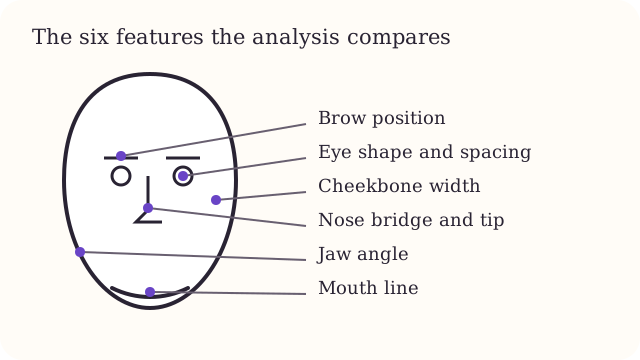
Proportion is heritable in broad strokes, and it is the part a comparison can see: overall face shape and the ratio of length to cheekbone width, the spacing of the eyes, the width of the nose bridge, the angle of the jaw, the line of the mouth, the height of the brow.
What is not visible in a photo is everything that makes resemblance feel obvious in a room: expression habits, the way a face moves when it talks, voice, posture, mannerism. Those are what relatives actually recognise, and none of them live in the pixels.
Why a photo comparison cannot settle it
Two structural limits apply to every face-matching tool, including this one.
It has nothing to compare against
A match needs a library. Ordinary family photographs are not a measured reference set, so there is no ranking to produce.
It cannot see inheritance
Sharing a jaw angle with a parent is not a fact a photograph can confirm. That is a question for a DNA test and a professional, not an entertainment tool.
The version that does have an answer
Ask instead: whose facial structure is closest to mine? That is a comparison against a measured set of faces, and it produces a ranked result, a resemblance score, and a list of the features that earned it.
This site runs that comparison against famous couples rather than single celebrities, because a pair splits your face across an upper and a lower half. The mother may carry your brow line and eye spacing while the father explains your jaw and mouth line, or the other way round. That split is the part of the result worth reading.
How to run the comparison properly
Three rules make the result worth trusting.
- Use a clean, front-facing photo. Even light, neutral expression, brow line visible, camera at arm's length.
- Change one variable at a time. If you re-run, change the photo angle or the light but not both.
- Read the alternates. The second and third pairs tell you which features are stable in your face and which were borderline.
When to take it seriously
Never, for family questions. Always, as a description of structure. The result tells you something real about the proportions of your face and attaches famous names to them for fun. Keep those two things separate and the tool is honest with you.
Frequently asked questions
Can you tell who my parents are from a photo?
No. Family relationships are not visible in a photograph, and no responsible tool will claim otherwise.
Do I look like my parents if people say so?
People are reading movement, expression and mannerism as much as structure. Those are real signals about family, and they are not something a photo comparison can measure.
What can a face comparison actually tell me?
Which measured features of your face are closest to which famous face, how close the match is, and which of your features carried it.
Is this the same as a DNA test?
No. A DNA test reads genetic markers. This compares visible proportions and is for entertainment only.