The wider question
Who Do I Look Like?
Who do I look like is the widest version of the question, and it has no single answer until you say what kind of match you want. A celebrity, an actor, a doppelganger or a parent pair are four different searches. Name the one you mean and the answer stops being a guess.
Sign in to unlock the full report and spend your free credit.
One question, several different searches
Who do I look like is usually asked before the asker has decided what they want back. A single famous face, the actor you could be cast beside, a stranger who happens to share your face, and the couple who could be your parents are four different answers to four different questions.
Each one is a comparison, but against a different list and for a different reason. The question stops being vague the moment you name the list.
A celebrity or an actor, first
Two of the narrower questions are about a single famous face.
- What celebrity do I look like returns the single famous face closest to your photo, with the features that carried it.
- Actor lookalike runs the same search against actors only, where faces are catalogued and lit for being looked at.
A doppelganger or a parent pair
Two more versions change the answer entirely.
- Find my doppelganger is the nearest face by proportion, and explains why that is not your twin.
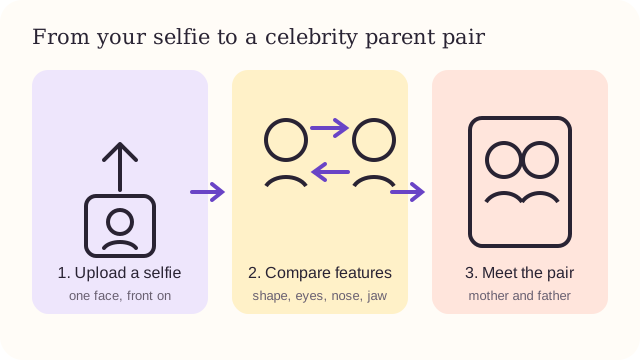
- Who are my celebrity parents splits your face across a couple, so two faces explain your upper and lower half at once.
Why the vague version has no stable answer
Without a list, there is nothing to rank against. The same face scores differently against celebrities, actors, strangers and couples, because each is a different library and a different measurement.
That is not the tool being unreliable. It is the question being unspecific. A face does not have one true match; it has a nearest neighbour in whichever list you point it at.
What narrows the question
One decision does almost all the work: what is on the other side of the comparison.
- One face or a pair? A single celebrity is a distance problem; a parent pair is a combination problem.
- Which list? All public faces, actors only, or a fixed roster of couples.
- What for? A name to laugh at, a type to be cast as, or a story about a family.
Answer those three and the search writes itself.
What every version shares
Whatever you narrow it to, the method is the same underneath. Six structural features — face shape and proportion, eye shape and spacing, nose bridge and tip, jaw and chin, mouth line, brow position — are measured on your photo and scored against a fixed list.
What changes between versions is the list and the output, never the honesty about what a photo can and cannot show.
Run it on your own photo
Upload one front-facing selfie and the generator runs the comparison both ways: the closest single face and the closest parent pair. The free run names both; one credit opens the score and the feature breakdown.
Frequently asked questions
Who do I look like, in one answer?
It depends on the list you mean. Against celebrities you get one name, against actors another, against a couple a parent pair. The question has an answer only once you name the list.
Why do I get a different answer on every site?
Each site measures a different feature set against a different roster. The nearest neighbour changes when the library or the ruler changes.
Is there a single true answer to who I look like?
No. A face has a nearest neighbour in any given list, not one true match in the world. Which answer you get is a property of the list, not a property of your face.
Which version should I run first?
Start with the celebrity search, then run the parent pair, which answers a harder question with two faces. Both run on the same selfie, and the first is free.