AI, honestly weighed
Celebrity Look Alike AI
A celebrity look alike AI can describe a face convincingly, which is exactly why its guess is hard to spot. An AI chatbot reads a selfie and produces the most plausible names; a matcher scores every face in a fixed roster and reports the nearest. Here is where each is the right tool.
Ready when you are
One selfie is enough. The single famous face closest to yours comes back free, and nothing is stored.
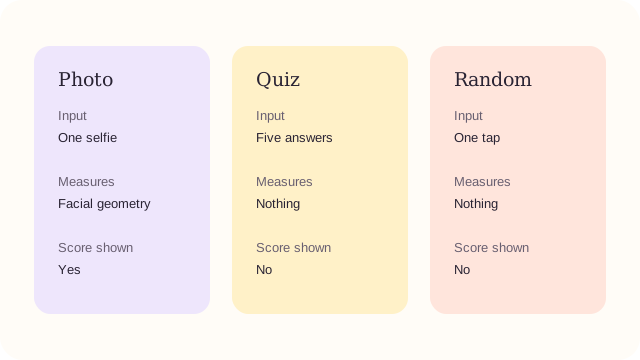
What a vision model sees in a selfie
Given a selfie, a vision model extracts a description. It can read that a face is long or round, that the eyes are wide-set, that the jaw is soft. Those observations are real, and they are the same family of features a matcher measures.
What the model cannot do from the image alone is rank. It has no fixed list of faces in front of it, so it has no way to score every candidate and report which one is nearest.
Hallucination versus measurement
A measurement returns a number that can be reproduced. A hallucination returns a name that sounds right.
The difference shows in the output. A matcher reports a score out of 100 and the features that carried it. An AI that is guessing reports a name and a flattering sentence, and cannot tell you what it rejected or why.
AI chatbot versus a fixed-roster matcher
Ask an AI chatbot who you look like and it produces the most plausible famous names for its description of your face. The confidence of the answer does not track the strength of the evidence.
The same question is walked through side by side on the ChatGPT celebrity look alike page. The short version: a chatbot generates, a matcher ranks.
Why an AI answer drifts between runs
Ask twice and an AI can name different people. Nothing was ranked, so nothing is stable. It also has no consistent library, so it can name anyone — which sounds like a strength until you need to know what it compared against.
A matcher fixes both variables. The same photo against the same roster produces the same result.
Where each is the right tool
- Want a description of your face? An AI is genuinely useful. Ask which features stand out and it will tell you.
- Want a ranked match with a score? Use a matcher, which compares against a fixed list and shows its working.
- Want a stable answer? Keep the photo identical between runs and use the matcher.
The fixed roster is the difference
The roster is the part most visitors never think about, and it decides everything. A matcher draws every candidate from one list of famous faces, so the comparison is like for like. An AI has no such list, so its answer is a plausible sample rather than a ranking.
That is why a matcher can be wrong in a useful way — you can check which face it picked and disagree with the score — while an AI guess is harder to challenge.
Try the measured version on your photo
The generator here is the measured version. The free run names the closest single face and the first parent pair; one credit opens the score and the feature breakdown. No guess, and the same photo gives the same answer.
Frequently asked questions
Can AI tell me which celebrity I look like?
It can produce a plausible name. It cannot score your face against a fixed roster, so it has no measurement to defend and no reason to give the same answer twice.
Is an AI celebrity look alike more accurate than a matcher?
For a ranked result, no. An AI generates a likely answer; a matcher compares fixed measurements against a fixed list and reports the nearest face with a score.
Why does an AI give a different answer each time?
A vision model describes your face and then generates the most plausible names for that description. With no fixed library and no fixed scoring, the names drift between runs.
When should I use an AI instead of a matcher?
When you want a description of your face rather than a ranking. Ask it which features stand out. Use a matcher when you want a scored result you can check.