Accuracy, examined
Most Accurate Celebrity Look Alike App
Searching for the most accurate celebrity look alike app assumes accuracy is a dial one product turned higher than the rest. In this category it is usually a method difference: four kinds of tool answer four different questions, and a number printed under a face does not mean the same thing in any two of them.
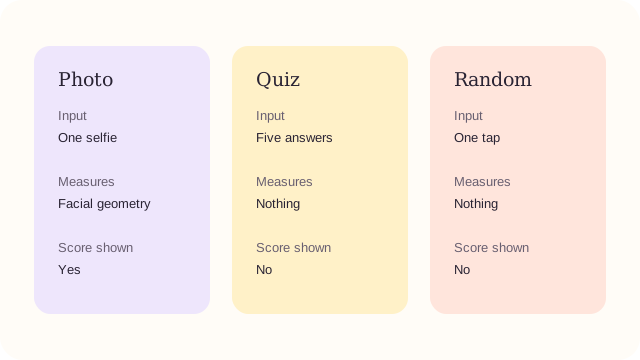
What accuracy can mean here
There are three separate questions hiding inside the word accurate. Does the app return the same answer twice for the same photo? Does the answer describe a measurement the app can show you? And does the answer correspond to anything true about the person, such as a family relationship?
The first is repeatability, and any deterministic tool can have it. The second is transparency, and it depends on whether the app names the features it compared. The third is the one nobody in this category can promise: a photograph of a face does not contain a family tree.
That is why a page claiming to rank apps by accuracy usually ends up ranking them by marketing. The useful comparison is between methods, and the rest of this page does that with published figures rather than adjectives.
Four methods sold under one name
A one-face lookup compares your photo against a library of single celebrities and returns the nearest neighbour. StarByFace describes exactly this: it detects the face, maps eyes, nose and mouth, and compares the face with celebrities. Its own page also notes that accuracy depends on the resolution and quality of the face image, which is a measurement statement, not a promise.
A parent-pair score compares one face against couples and ranks how well two faces could blend into it. This site does that against 50 famous couples, using six named measurements. It is still a resemblance reading, but the unit being ranked is a pair rather than a person.
A generative filter, such as the CapCut celebrity parents template, produces a video or image with two celebrities placed beside you. The output is a new picture, not a ranking, and the template does not publish how the pair was chosen. It is good at being a costume; it is not a measuring instrument.
An AI chat answer produces names from a language model. It can sound confident and still be a guess, because the model is generating a plausible answer rather than comparing pixels to a fixed roster.
None of these methods is a more accurate version of another. They answer different questions, and the first check before believing any result is to work out which one you are looking at.
What the kinship benchmarks actually show
The closest thing to an accuracy benchmark for this category is facial kinship verification: deciding whether two faces are related. The standard public dataset is Families in the Wild (FIW), which contains 26,116 face images from 1,000 families across 11 kinship types, including father-son, mother-daughter and sibling pairs.
A 2026 VISAPP paper reporting a new state-of-the-art method puts the best average pairwise verification accuracy on FIW at 82.17%, with tri-subject verification, where the task is to decide whether a child belongs to a parent pair, at 86.5%. Those are the best published numbers on a curated benchmark, not the performance of a phone app on a party selfie.
Read the error rate rather than the headline. At 82.17%, roughly one pair in five is classified incorrectly on a benchmark built for the task. The paper also reports weaker results for some kinship types than others, which is the useful detail: a single average hides the cases where the method struggles.
And a benchmark is not a product. FIW pairs are labelled family relationships; a celebrity look-alike app is ranking visual similarity against a fixed roster. A high score on the first does not transfer to the second, because the second is a different question.
Sources: the FIW dataset description and the 82.17%/86.5% figures come from Barbosa and Vieira, "Kinship Verification with Custom Sampling and Hard Contrastive Loss" (VISAPP 2026), checked 21 October 2026. The paper is linked at the end of this page.
NIST: accuracy is not one number across faces
The other reason to distrust a single accuracy figure is that error rates are not uniform across people. NIST's face-recognition vendor tests measured demographic differentials across almost 200 algorithms, four photo collections, more than 18 million images and more than 8 million people.
Its headline finding is blunt: false positive rates often vary by factors of 10 to beyond 100 times across demographics. With higher-quality application photos, false positives were highest for West and East African and East Asian people and lowest for Eastern European individuals; some algorithms developed in China reversed that pattern. The report also found higher false positives for women than men, and elevated rates for the elderly and for children.
This does not mean a celebrity look-alike app is wrong for you. It means "the most accurate app" is not a property a vendor can establish with one number, because the error rate depends on the face, the photo and the algorithm together. A tool that shows its measurements lets you see which features drove the result; a tool that shows only a percentage asks you to trust an average that may not describe you.
Source: NIST Internal Report 8280, "Face Recognition Vendor Test Part 3: Demographic Effects", checked 21 October 2026.
Why a celebrity parents result is not a DNA answer
A parent-pair result is a statement about geometry. The matcher compares face length, cheekbone width, eye spacing, nose bridge, jaw angle and mouth line against each couple in its fixed roster, then reports which pair and which features carried the score.
That is a real comparison and it can be repeated, which is more than a generated image can offer. It is still not evidence of relatedness. A child inherits half of each parent, and which half is not visible in anyone's face; two siblings from the same parents can resemble neither. A high score means the proportions fit a pair in the roster, not that the pair are your relatives.
The roster is also a hard limit. Fifty couples means fifty possible answers, and a celebrity who is not on the list can never come back as your match. An app that does not tell you the size of its roster is asking you to mistake a small library for the whole world.
How to test an app in five minutes
- Run the same photo twice. A deterministic tool returns the same pair. A generated image or a chat answer will drift, which tells you it is not measuring.
- Ask what the roster is. A named, countable list can be checked. "Thousands of celebrities" with no list cannot.
- Look for features, not just a score. A percentage without a feature breakdown is unfalsifiable. Eyes, nose, jaw and mouth let you disagree precisely.
- Read the limits statement. A tool that says it is entertainment is more trustworthy than one that implies a family result.
- Check what happens to the photo. A stored selfie has a different risk profile from one that is analysed and discarded. This matters more than a few points of resemblance.
The methods side by side
| Method | What it returns | Repeatable | Shows its measurements | Typical cost |
|---|---|---|---|---|
| One-face lookup | The nearest single celebrity | Yes, with the same photo and library | Sometimes a similarity score | Free to paid |
| Parent-pair score | A couple, a score and a feature breakdown | Yes, with the same photo and roster | Yes, by design | Paid credit per report |
| Generative filter | A video or image with two celebrities | No, each run can differ | No published method | Free template or app subscription |
| Generative image tool | A new picture of a family scene | No, each run is a new drawing | No | Credits or subscription |
| AI chat answer | Names in text | No, wording and names can change | No roster or measurement | Free to subscription |
The table is the short answer to the search. If you want a repeatable reading with named features, a scored pair is the method to choose. If you want a shareable costume, the filter is better at that job, and it is not pretending to measure.
Where this site sits, stated plainly
This site scores a face against 50 famous couples and returns the three closest pairs, the closest single famous face, the scores, the six-measurement breakdown and a share card. One paid credit covers the report. Photo analysis requires an account and a credit pack; there is no free photo analysis and no second charge to unlock the report.
The photo is used for the analysis request and discarded; the structured verdict is stored so the share page keeps working. The roster is fixed at 50 couples, so a celebrity outside it cannot appear. The result is entertainment, not a DNA test, a paternity test or a biometric identification, and the feature breakdown exists so you can argue with the answer instead of just accepting it.
If a single name is what you wanted, the one-face route is the honest tool; start with what celebrity do I look like. If you want the couple answer, run who are my celebrity parents. If you are comparing this with the TikTok template, read StarByFace vs CapCut, and for the four popular tools in one table, see best celebrity parents generator.
Sources
Every figure in this guide was read from the source on 21 October 2026.
- StarByFace: one-face celebrity comparison and the statement that accuracy depends on image resolution and quality.
- Barbosa and Vieira, VISAPP 2026: FIW dataset size (26,116 images, 1,000 families, 11 kinship types) and 82.17% pairwise / 86.5% tri-subject verification accuracy.
- NIST IR 8280, Face Recognition Vendor Test Part 3: demographic differentials, including false positive rates varying by factors of 10 to beyond 100 times.
No app in this category publishes a selfie-based accuracy figure, and none of the numbers above are ours.
Frequently asked questions
Which celebrity look alike app is the most accurate?
No app publishes a selfie-based accuracy figure, so there is no honest ranking. The useful distinction is the method: a one-face lookup, a scored parent pair, a generative filter and an AI chat answer return different things, and only the first two can repeat the same result for the same photo.
What does 82% accuracy mean for a celebrity parent match?
It is the best published pairwise score on the FIW kinship benchmark, where roughly one pair in five was still classified incorrectly. That benchmark uses labelled family relationships; a look-alike app ranks visual similarity against a fixed roster, which is a different task.
Can an app tell me whether I am related to a celebrity?
No. A photograph shows facial geometry, not ancestry. A match means the proportions fit a pair in the app's roster, not that any family relationship exists.
Why do two apps give me different celebrity parents?
They use different rosters and different methods. A single-face tool returns one nearest neighbour, a pair matcher optimises a blend of two faces, and a generative filter renders a new image. Different questions produce different answers.
Are free look-alike apps less accurate?
Price does not determine the method. A free one-face lookup can be deterministic, and a paid generative tool can be non-repeatable. Check repeatability and whether the app names its measurements rather than judging by price.
Does using AI make a celebrity match more accurate?
Not automatically. A language model generates a plausible answer rather than comparing your pixels to a fixed roster. A deterministic matcher with named features is easier to check, even though it is less flexible.
How do I get a repeatable result on this site?
Use the same photo and the same roster. The matcher returns the same pair, the same score and the same six-feature breakdown each time, and one paid credit covers the full report.