AI, honestly
AI Chooses My Celebrity Parents
AI chooses my celebrity parents is a phrase that travels faster than the technology behind it. Here is what an AI system can genuinely see in a selfie, where it starts guessing, and why one kind of match gives you the same answer twice.
Ready when you are
One selfie is enough. Your first result is free and nothing is stored.
What people mean by the phrase
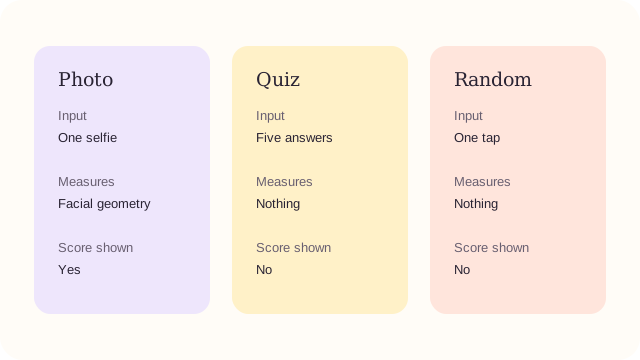
Mostly they mean one of three things: a video effect that labels two famous faces as your parents, a chatbot that names a couple when you describe yourself, or a tool that compares your photo against a real roster of faces. The first two are performance. The third is measurement, and it is the only one that can show its work.
What an AI can actually read from a photo
With a clear, front-facing image, a vision model can identify describable structure: the ratio of face length to cheekbone width, how far apart the eyes sit relative to their size, the width and position of the nose bridge and tip, the angle of the jaw, the line of the mouth, the height of the brow.
Those are the features a look-alike comparison actually runs on, and they are stable enough to be useful. Everything past them — personality, ancestry, family, attractiveness — is not in the pixels.
Where the guessing starts
A model asked to name your celebrity parents without a roster to measure against will produce something plausible rather than something verifiable. Two effects show up immediately.
The answer moves between runs
Ask the same question twice and you can get two different couples, because nothing is being scored against a fixed list. Variation between runs is the signature of a guess.
The answer matches the prompt
Lead the model toward a genre, an era or a name and the answer drifts that way. That is conversational behaviour, not facial analysis.
What a measured match does instead
A measured match fixes both variables. The roster is fixed, so every couple is drawn from the same list. The rubric is fixed, so the same measurements produce the same ranking every time. You get a pair, a resemblance score out of 100, and a written list of which features carried the score — the part that lets you argue with the result instead of just accepting it.
Getting a repeatable answer
Three habits separate a reproducible result from a random one.
- One photo, one variable. Change the light or the angle, never both, or you will not know which one moved the score.
- Front-facing and unstyled. A turned head compresses one half of the face and quietly rewrites the geometry.
- Read the alternates. Pairs two and three tell you which features are stable in your face. The single winner on its own tells you very little.
Keep it in its lane
This is entertainment, and the honest version of it says so. A face-matching tool cannot tell you anything about your family, cannot identify a person, and cannot confirm a relationship. It compares structure, names a pair, and stops there. Anything more confident than that is not coming from the photo.
Frequently asked questions
Can AI really tell who my celebrity parents are?
It can tell you which famous couple comes closest to your facial geometry, which is a resemblance question. It cannot tell you who your parents are, and no photo can.
Why does ChatGPT give a different answer each time?
Because a chat model is generating a plausible reply, not scoring your face against a fixed roster. With no fixed list and no fixed rubric, the answer drifts between runs.
What makes a match repeatable?
A fixed roster, a fixed set of measurements, and the same input photo. Score a couple against landmarks rather than against an impression and the ranking stops moving.
Does the AI store my photo?
Not here. The photo is analysed once and discarded. It is not saved to a library and it is not used to train a model.